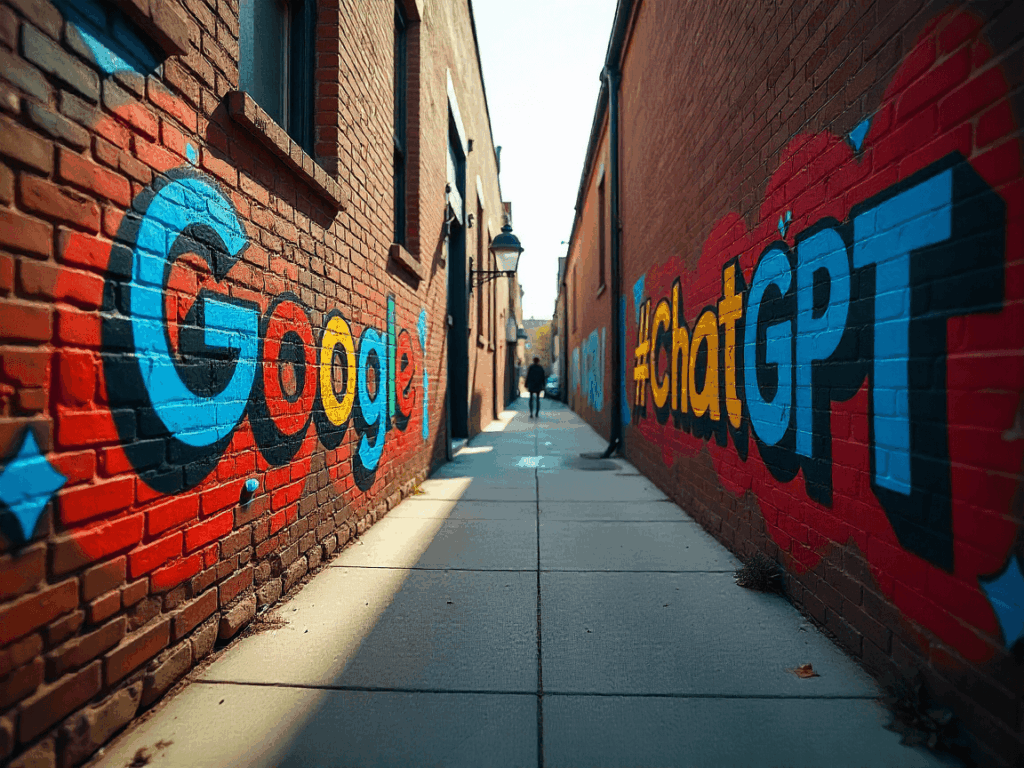
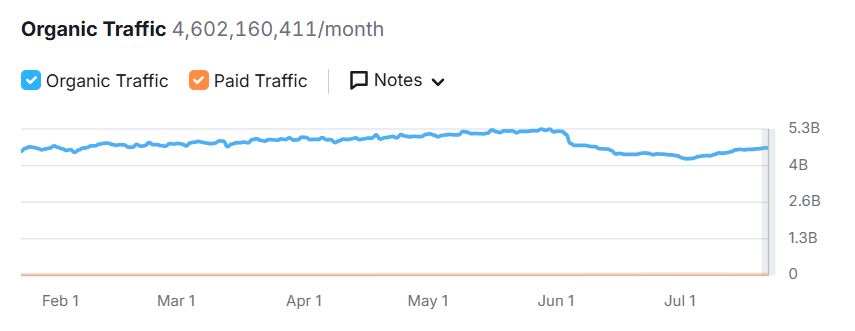
The digital landscape is witnessing an upheaval unlike any we’ve seen in decades. In recent months, data has shown an unprecedented shift in web traffic: traditional search engines are seeing declines, while AI-powered tools are skyrocketing in usage. For example, third-party analytics suggest Google’s Canadian site (Google.ca) attracted nearly 40 million visits in May but plummeted to under 10 million by mid-summer, a staggering drop.
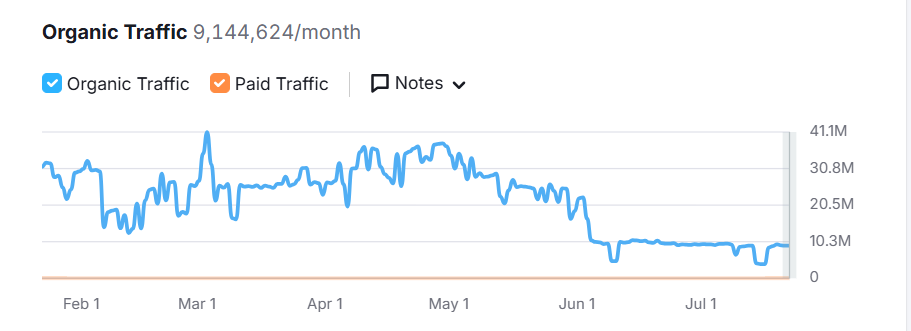
Globally, even the main Google.com portal reportedly shrank from about 5.3 billion visits to 4.0 billion in the same period.
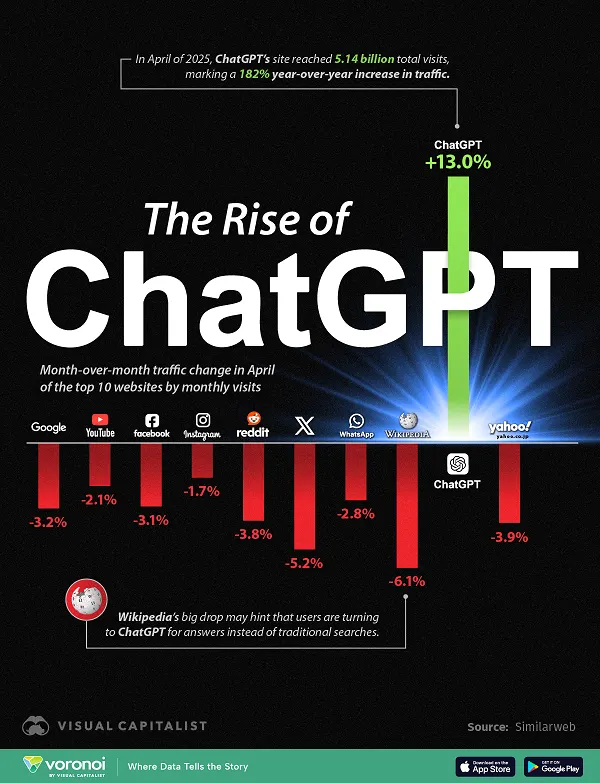
Where did all those users go? Increasingly, it appears they turned to AI – platforms like OpenAI’s ChatGPT and others built on generative AI – to find information. In fact, one analysis of April 2025 web trends found that ChatGPT’s website was the only one among the top 10 sites to gain traffic, surging by 13% in a single month, even as giants like Google, YouTube, Facebook, and Wikipedia all saw declines. We seem to be at the dawn of a new era where conversational AI is reshaping how people search the web.
What does this all mean? Are we witnessing the downfall of Google’s search empire at the hands of AI? And how will this “battle of the tech titans” impact everyone else – especially entrepreneurs, marketers, and small business owners who rely on the web to reach customers? In this comprehensive deep dive, we’ll explore the evidence and emerging trends behind this Google vs. AI showdown. More importantly, we’ll distill what you can do to navigate the upheaval.
Spoiler alert: The outcome is far from settled – Google isn’t necessarily doomed to lose, and AI isn’t guaranteed to win. But in a clash of such giants, the only safe bet for smaller players is on themselves. Read on to understand why, and how to adapt.
The Surprising Shift in Web Traffic
It’s hard to overstate how dominant Google has been on the internet. For over 20 years, “Google” has been virtually synonymous with searching for information online. By the mid-2010s, Google’s share of global search engine usage hovered around 90-92%, an unassailable monopoly. As recently as 2022, Google.com was the most visited website on Earth by a huge margin, handling over 13 billion searches per day according to some estimates. But suddenly, for the first time in a long time, that dominance is showing cracks. Statistics from late 2024 revealed that Google’s global search market share dipped below 90% for the first time since 2015, breaking a decade-long streak. By the end of 2024, Google hovered around 89% share globally – a small drop, but a symbolic one. In the U.S., Google’s share likewise slipped to the high-80s.
Importantly, this wasn’t because users flocked to other traditional search engines like Bing or Yahoo. In fact, Bing’s usage has been inconsistent (a brief uptick when it launched an AI chatbot, then a decline), and other search engines remain niche. So where are people going instead of Google? Increasingly, to AI-powered tools and chatbots. StatCounter and similar trackers don’t yet count AI chatbots as “search engines,” but many observers believe the rise of AI is siphoning off Google’s search queries. Consider that by early 2025, ChatGPT’s own traffic had exploded to over 5 billion visits per month, making it the 5th most-visited website in the world. ChatGPT’s traffic in April 2025 alone was up 182% year-over-year, reaching 5.14 billion visits. This growth is astonishing – and it correlates with a measurable drop in visits to search-centric sites. In April 2025, as ChatGPT surged, web analytics noted that all of the other top 10 websites lost traffic: Google’s visits dipped ~3%, YouTube ~2%, Facebook ~3%, and Wikipedia suffered a 6% fall in just one month. The trend continued into May, with ChatGPT usage still climbing (another ~7% increase to 5.49B visits) while a social platform like X (formerly Twitter) grew only 1%.
The takeaway is clear: user behavior on the web is changing. People aren’t just typing keywords into a search box and clicking results like they used to. Now they’re increasingly asking questions to AI chatbots and getting direct answers. Why scroll through a page of blue links and ads when you can get a conversational answer that feels tailored to your question? ChatGPT’s easy, chatty interface – and the sheer novelty of AI that talks back with detailed answers – has captured the world’s attention. In doing so, it has started to encroach on Google’s core function as the “answer engine” of the internet.
It’s not just OpenAI’s ChatGPT, either. The broader “generative AI” boom includes Microsoft’s Bing Chat (powered by OpenAI’s tech), Google’s own AI experiments like Bard and the new Search Generative Experience (SGE), plus a host of others like Anthropic’s Claude, Perplexity.ai, YouChat, and more. But among these, ChatGPT has a massive first-mover advantage – it became a household name and hit 100 million users in record time in early 2023, and usage has only grown since. In the AI search arena, ChatGPT currently holds an 80%+ market share by usage, absolutely dwarfing other AI search tools. Even as rivals proliferate, ChatGPT remains the flagship product synonymous with this shift in search behavior.
From Google’s perspective, this is a scary change. Search is Google’s golden goose – it drives billions in ad revenue and funnels traffic across the web. If users start bypassing Google for AI assistants, that threatens not only Google’s traffic but the whole ad-supported ecosystem of the web. No wonder some within Google see this as an existential moment; internal discussions leaked in 2023 revealed Google execs acknowledging that generative AI could disrupt search and that Google needed to radically adapt to avoid losing users to ChatGPT-like tools.
Yet, this isn’t a simple story of “Google down, ChatGPT up.” It’s more complex. Let’s unpack the dynamics further by looking at how Google and Microsoft (OpenAI’s key backer) have responded, and how content creators are pushing back in turn.
A War of Titans: Alphabet vs. Microsoft (and the AI Arms Race)
When OpenAI launched ChatGPT to the public in late 2022, few could have predicted the chain reaction it would set off. Microsoft, smelling an opportunity to finally challenge Google’s search dominance, poured fuel on the fire by investing heavily in OpenAI and integrating ChatGPT’s technology into its Bing search engine and Edge browser. By early 2023, Microsoft was boldly advertising “the new Bing” with AI chat features – even going so far as to say “may the best AI win” in a direct challenge to Google. This was something the industry hadn’t seen in years: a feature-driven offensive against Google’s core search product.
Google initially seemed on the back foot – a rare place for the search giant. Reports emerged that Google declared a “code red” internally, scrambling to deploy its own AI answers to search queries. By mid-2023, Google unveiled Bard, an experimental conversational AI, and in late 2023 it began testing AI-generated summaries on search results pages (the SGE feature) to directly answer user queries with AI. Sundar Pichai, Google’s CEO, emphasized that Google was infusing AI across all its products, trying to catch up in the narrative that Microsoft had seized. In essence, the battle lines were drawn: search engines versus AI chatbots – or perhaps more accurately, search engines with AI versus standalone AI chatbots. Alphabet (Google’s parent) and Microsoft became the chief rivals, each racing to outdo the other in AI capabilities.
However, this battle is not happening in a vacuum. The entire digital ecosystem is feeling the tremors. As Google and Microsoft duel, they are fundamentally changing how content is delivered to users:
- Google, in defending its turf, is reshaping its search results. Traditional SEO (Search Engine Optimization) is suddenly sharing space with what some call GEO – Generative Experience Optimization. Websites that used to count on a #1 Google ranking for traffic now find that above their link, Google might display an AI-generated overview that already answers the question. Early studies show these AI “instant answers” on Google can sharply reduce clicks to websites – one analysis found sites that previously ranked first lost up to 79% of their traffic when Google’s AI overview appeared ahead of them. Google’s own research (pre-AI) had noted that featured snippets and answer boxes led to 75% of mobile users never clicking through – they got what they needed on Google itself. This is so called Zero-Click Searches. Now, with fully AI-generated answers, the tendency for users to stay on Google rather than visit external sites is even stronger. In short, Google has quietly been keeping more traffic for itself by answering queries directly – a strategy to compete with ChatGPT’s direct answers.
- Microsoft, via OpenAI’s ChatGPT and Bing, has taken a different approach – one that ironically raises even more concerns for content creators. ChatGPT doesn’t just give you a snippet; it can generate whole paragraphs, articles, code, you name it – drawing from its vast training on internet data. But when it gives you an answer, it often doesn’t directly show where that information came from (unless specifically prompted or in newer versions that attempt citations). For users, this feels magical – “the AI writes just for me!” – but for publishers and creators, it feels like their content is being digested and served up without credit. In effect, AI models like ChatGPT “scrape” the web during training and use all that knowledge to respond to users, without driving traffic back to sources. To many writers, artists, and site owners, this looks like wholesale plagiarism or at least a raw deal: their work fuels the AI, yet they get zero recognition or revenue from its answers.
It was perhaps inevitable that this situation would lead to conflict. As I wryly observed, nobody expected the fight between Alphabet and Microsoft to kick off in this way – a high-stakes showdown over AI that’s upending the traditional web traffic balance. But here we are: Google’s search empire is being challenged by AI products, and Google is answering with more AI of its own. In the meantime, content creators find themselves squeezed from both sides – by Google keeping more clicks and by AI bots taking their content wholesale. Tensions have been mounting throughout 2023 and 2024, with louder and louder grumblings from publishers about AI “stealing” content and traffic.
This all set the stage for an extraordinary development in mid-2025: a pushback led not by Google or Microsoft, but by a company that quietly underpins a huge chunk of the internet’s infrastructure – Cloudflare.
Content Independence Day: Publishers Strike Back
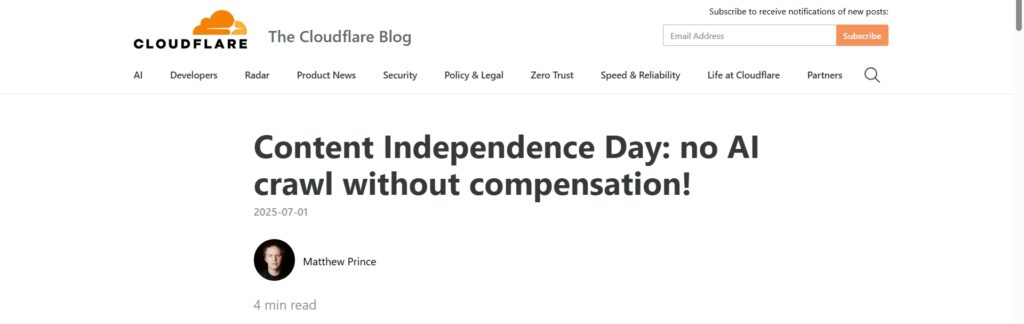
On July 1, 2025, Cloudflare (a popular web infrastructure and security company powering millions of sites) made a bold announcement: it declared “Content Independence Day,” stating that AI crawlers would be blocked by default from accessing content unless they pay for it. This was a rallying cry for content creators’ rights, and it sent shockwaves through the industry. Cloudflare’s CEO, Matthew Prince, framed it in almost revolutionary terms. For nearly 30 years, he explained, the web operated on a simple deal: search engines could crawl your site and index your content, and in return they’d send you traffic. Google epitomized this deal – it would copy your webpage into its index, but then users searching could click through to your page, letting you earn ad revenue or sales. This traffic-for-content bargain is what allowed the web’s content ecosystem to flourish for decades.
Prince argued that this deal has now broken. Google itself has changed (with answer boxes and AI summaries reducing outbound traffic), but at least Google still attempts to send visitors to sources. The newer AI tools do far less of that. In Prince’s vivid words, “the web is being strip-mined by AI crawlers with content creators seeing almost no traffic and therefore almost no value”. His most striking statistic: Using content on ChatGPT (OpenAI) is 750 times less likely to result in a visitor to the source site compared to the old Google model. With Anthropic’s Claude (another AI chatbot), it’s 30,000 times less likely! Those numbers are staggering – essentially highlighting that if you rely on AI bots to disseminate your content, you might never see users coming to your site at all. Compare that to Google of yore, where a top-ranked article could expect a flood of visitors.
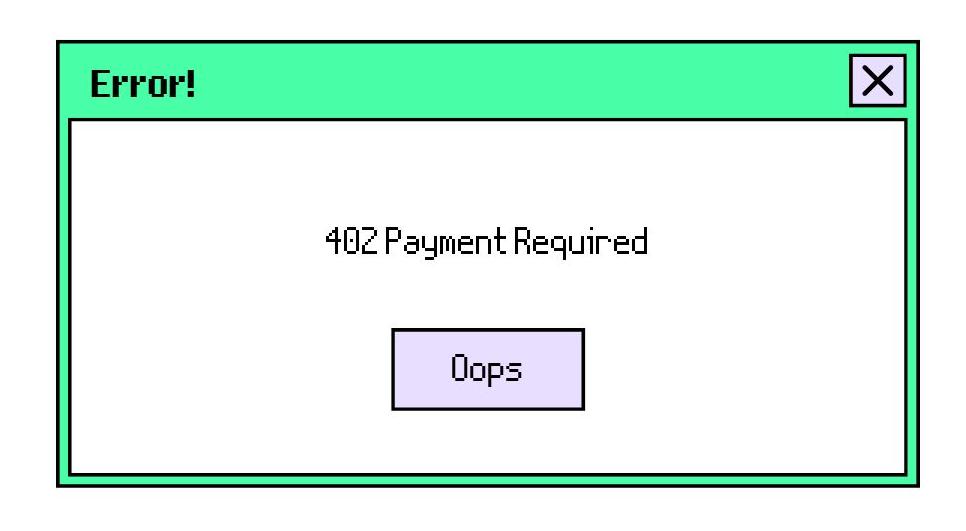
So, Cloudflare decided to use its leverage to change the rules of engagement. They introduced a feature called “Pay Per Crawl” – an option for site owners to demand payment from AI scrapers in exchange for access to their content. Rather than just blindly allowing or blocking bots, content creators can now set a price (even a fraction of a cent) for each request. If an AI crawler (like OpenAI’s GPTBot) wants to scrape the site, it must show intent to pay via a new HTTP 402 “Payment Required” mechanism, or else Cloudflare will deny it. It’s a bit like putting up a toll gate for data. Importantly, Cloudflare isn’t forcing anyone to charge – site owners could still allow any bots for free or block entirely – but they’re providing the infrastructure to demand compensation at internet scale.
Cloudflare’s move flipped the default stance toward AI bots. Instead of the onus on each site to block what they don’t want, the new stance is “no AI access unless you pay” – effectively requiring AI companies to negotiate content deals or at least micro-payments. And Cloudflare didn’t act alone; they coordinated with “a majority of the world’s leading publishers” in this initiative. This suggests many big media organizations and content platforms are on board with the idea that AI should not get a free ride on their work. In Prince’s words, “that content is the fuel that powers AI engines, and so it’s only fair that content creators are compensated for it.”
This declaration – Content Independence Day – might be remembered as a turning point. For the first time, a large swath of the web is saying to AI companies: pay up, or no access. It’s essentially an attempt to enforce the old deal (value in exchange for value) in a new form. Some have compared it to a “strike” by websites, or a new data labor movement where the labor (content creation) must be paid for if used to train AI.
Will it work? Early indications are that the major AI players at least have to take it seriously. OpenAI, Google, Meta, and others can’t easily ignore Cloudflare given how many sites use its services as a gatekeeper. If Cloudflare’s paywall is widely adopted, AI bots might suddenly find much of the web off-limits unless they open their wallets. It could force a wave of licensing deals – perhaps similar to how music streaming services had to start paying record labels, AI firms might have to pay content owners.
Cloudflare’s stance also highlighted a willingness to enforce rules that goes beyond the honor system of the past. They referenced resurrecting the almost-forgotten HTTP 402 status code (“Payment Required”) as a tool – a code that was always reserved for future use but never utilized. Now it has a purpose in the AI age. Cloudflare essentially is providing the technical muscle to back up website owners’ rights.
It’s worth noting that not everyone wants to block AI bots – some creators actually welcome being included in AI training or answers, seeing it as the future of discovery (akin to SEO for AI). For instance, certain bloggers or developers might want their content to be used by ChatGPT so that they or their product get mentioned when users ask relevant questions. But the key is control and choice. Cloudflare’s framework allows each site to decide: allow, charge, or block, on a per-crawler basis. This granular control is something that was hard to enforce before. Robots.txt (the old standard for guiding web crawlers) is a polite suggestion, not a strong gate – and as we’ll see in the next section, not all AI bots even obey it.
For small businesses and entrepreneurs, Cloudflare’s move is encouraging in that it shows content creators are fighting for their interests. It could mean that in the near future, if you publish valuable content, you might get paid when AI models use it. At minimum, it means the status quo – where your content can be gobbled up by any bot – is being challenged. But technology aside, why did it come to this? A big factor is trust – or the lack of it – in how AI crawlers behave compared to the Googlebot we all knew. That brings us to the next key piece of the puzzle: GPTBot vs. Googlebot.
GPTBot vs. Googlebot: A Tale of Two Crawlers
Let’s talk about bots – the software “spiders” that crawl websites. For decades, Googlebot has been the main crawler visiting sites, indexing pages for Google. Website owners became accustomed to Googlebot’s patterns and, crucially, its respect for certain rules. If you didn’t want Google to index a page, you could put “Disallow” in your robots.txt file, and Google’s crawler would obediently stay away from that page. While not perfect, a kind of gentlemen’s agreement existed: robots.txt would guide the bots, and reputable crawlers would comply. This is part of why publishers were comfortable letting Google crawl everything – they trusted Google to honor their do-not-index requests and in return deliver traffic for the rest.
Now enter GPTBot, OpenAI’s web crawler launched around mid-2023 to gather data for training ChatGPT and other models. GPTBot, in theory, also respects robots.txt instructions – OpenAI even published instructions for site owners on how to disallow it. But in practice, things have been… messy. There have been multiple reports of GPTBot (or at least ChatGPT’s usage of data) ignoring site restrictions and using content that was explicitly off-limits. For example, technology commentator Jonathan Bailey recounted how he had added rules to block GPTBot on his site in 2023, yet when he asked ChatGPT about recent news, the AI essentially regurgitated his private blog content back to him. It even cited his site as a source, indicating the model had indeed trained on or accessed his posts despite the disallow directive. Understandably, he was not pleased – to put it mildly.
He’s not alone. Major publishers have reacted strongly against GPTBot. The New York Times made headlines by not only blocking GPTBot via robots.txt but also reportedly considering legal action against OpenAI for unauthorized use of its articles. According to one study, by late 2023 over 30% of the top 1000 websites had banned GPTBot in their robots files. To put that in perspective, GPTBot is by far the most blocked crawler on the web right now. Many sites that don’t bother to block anything else have a line that essentially says “User-agent: GPTBot – Disallow: /”, meaning “keep out, OpenAI.” By contrast, Google’s new Google-Extended crawler (used for AI training) and other AI bots have faced fewer bans – only a fraction of sites explicitly block them. GPTBot has become, as one headline put it, “the villain of robots.txt” because content creators see it as a direct threat.
Why this hostility? It comes down to perceived behavior and impact. Googlebot might scrape your site, but it won’t publish your content verbatim – it just indexes for search. GPTBot, however, feeds into an AI that might actively produce text based on your content without always sending users your way or even correctly crediting you. Many feel that’s effectively plagiarism. Indeed, Bailey’s example above shows ChatGPT rewording his article and presenting it as an answer, with only a token link at the bottom that few users would likely click. In another case cited by 404 Media, ChatGPT’s AI summaries led to just a single subscriber referral for their site – despite presumably hundreds or thousands of people reading AI-generated answers derived from their reporting. This one-way relationship (AI gets the content, creator gets nothing) is what Cloudflare and others are railing against.
From a rules perspective, it appears GPTBot’s interpretation of “disallow” is limited – OpenAI said blocking GPTBot would mean your content isn’t used for training new models. However, if your content was already out on the web prior to that, it may have already been ingested into GPT-4’s knowledge base. Or perhaps GPTBot’s block doesn’t stop the ChatGPT web browsing feature from fetching your page (if a user explicitly asks for it and browsing is enabled). The result: even sites that thought they opted out might still see AI churning out their text. It’s understandably infuriating to those who took steps to protect their work.
The trust that Google built over years – by being relatively transparent and by sharing value back – simply isn’t there with OpenAI’s bot. Google also invested in tools to help publishers (analytics, ad platforms, etc.), whereas OpenAI is a newcomer with a more opaque approach. Thus, GPTBot quickly earned a reputation as a rogue scraper that content creators felt they needed to block outright. By mid-2025, it was the single most blocked user-agent on the web, according to Cloudflare’s analysis.
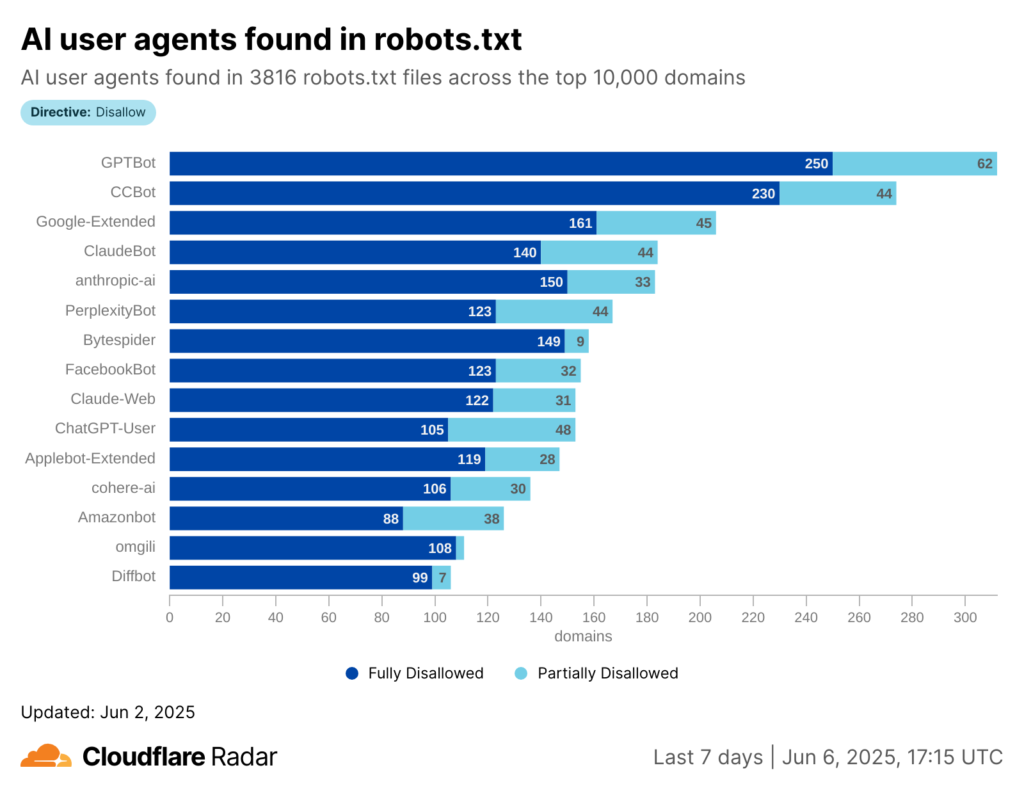
As the chart above shows, GPTBot isn’t only the most blocked bot – interestingly, Cloudflare found it’s also the most explicitly allowed bot on some sites (around 61 domains actually made a point to allow GPTBot). Why would anyone allow it? Likely those are cases of AI-friendly sites or experiments, or perhaps businesses that want their content in AI outputs. But those are rare. The vast majority of references to GPTBot in site rules are to shut it out.
Beyond robots.txt, many websites are taking stronger measures, like outright firewalling AI crawlers or using bot detection to serve them nothing. Cloudflare notes a shift from passive measures (like a polite exclusion file) to active defenses (like its own firewall or other tools) to enforce content rights. In other words, webmasters are no longer just asking bots to behave – they are starting to use technical force.
This adversarial turn is unprecedented in the history of web crawling. For small businesses and site owners, it raises questions: should you be blocking AI bots on your site? If you rely on content that you’d rather not have regurgitated by an AI without credit, perhaps yes. On the other hand, if being part of AI answers might increase your brand exposure (even without direct clicks), maybe not. It’s a tough call, and one each business has to weigh. The new Cloudflare “pay per crawl” system adds another option: you could allow GPTBot if it pays – turning a leech into a customer, essentially.
A subtle but important point here is that GoogleBot and GPTBot are not equal in capabilities or intent. Google’s bot mostly downloads text and follows links for indexing. GPTBot is likely trying to vacuum up everything – including parsing raw text to feed into a language model. This difference in mission (indexing vs. training) means GPTBot can be heavier and potentially more aggressive in crawling patterns. Indeed, Cloudflare observed that from May 2024 to May 2025, GPTBot’s traffic exploded by 305% – far outpacing Googlebot’s 96% growth in the same period. By May 2025, GPTBot jumped to being the #3 source of crawler traffic on Cloudflare’s network (behind only Googlebot and Bing’s bot), whereas a year prior it was barely in the top ten. This surge reflects how hungry AI models are for more and more data – but to site owners, it may feel like an invading army of bots descending on their servers.
So we have a classic trust gap: Googlebot is the familiar visitor who (mostly) follows the house rules; GPTBot is the new guy who shows up uninvited and raids the fridge. Cloudflare’s aggressive stance on AI bots can be seen as an attempt to enforce discipline on the new crawlers that hasn’t been earned through trust. And in fairness, OpenAI did give the world a heads-up by providing a way to block GPTBot – effectively admitting that not everyone would consent to its data scraping. Many took them up on that.
All this sets the stage for an epic confrontation. On one side, we have Google – huge, established, but forced to reinvent itself with AI and facing its first real decline. On the other, we have the AI disruptors – growing fast, but now facing a united front of web publishers who could choke off their lifeblood of data. It’s a battle for the very future of the web’s knowledge economy. So, who’s going to win? Or is there a truce possible? In the next section, we’ll analyze why Google isn’t necessarily out of the fight, and why AI hasn’t sealed victory yet. The outcome is likely to be nuanced, and that’s where opportunities and risks for smaller players emerge.
Google Isn’t Done Yet (Why Google Could Still Hold Its Ground)
With all the hype around AI, one might think Google Search is about to go the way of the dodo. But hold on – Google is far from powerless. History has shown Google to be extremely resilient and resourceful in the face of challenges. Let’s consider a few reasons why Google might not only survive this AI storm but continue to be a dominant force:
- Massive Scale and Data: Google still handles billions of searches every single day, dwarfing any single AI chatbot’s usage. In July 2025, Google.com was still the #1 website on the planet with an estimated 105 billion monthly visits, more than double the next site (YouTube). Even if usage dips a few percentage points, Google remains an integral part of how the world navigates online information. Moreover, Google’s index of the web – and the real-time data it collects through search queries, Chrome browser, Android devices, etc. – is an asset no one else can match. If it leverages that data to improve its AI models (and it is doing so), Google could theoretically produce AI answers as good or better than OpenAI’s, but with the advantage of direct integration into search and up-to-the-minute knowledge of trending queries.
- AI Integration (Gemini and SGE): Google is not standing still. It has deep AI research expertise (remember, Google’s DeepMind and Brain teams were pioneers in AI long before ChatGPT caught fire). The company is working on Gemini that aims to rival or surpass GPT-4 in capabilities. Google has already integrated AI summaries into search results (initially as an opt-in experiment through Search Generative Experience). This means Google can offer the convenience of AI answers while still being within the Google platform. For users, that might become the best of both worlds: you get an AI-powered answer for simplicity, but if you want to verify or go deeper, the source links are a click away (and conveniently, you’re already on Google’s page which can monetize your attention with ads). Google’s challenge is to execute this carefully – if the AI answers are bad, users lose trust; if they’re too good, users might not click anything (harming publishers). It’s a delicate balance, but Google at least has the distribution pipeline to roll out AI to billions of users overnight via Search and Chrome updates. That’s a huge advantage.

- Ecosystem and Default Status: We can’t ignore the power of defaults and habit. Google is the default search on essentially every device (outside of Apple devices where it pays to be the default). Android phones use Google. Millions have Google as their browser homepage. Chrome’s address bar is basically a Google search box for most. This inertia means that even if ChatGPT is amazing, a lot of people will still reflexively “Google it” simply because it’s ingrained behavior. Changing mass consumer behavior is hard and often slow. Plus, Google can and does improve its results constantly – it’s not as if the search engine is stagnant (they do core algorithm updates frequently to enhance quality, sometimes causing noticeable traffic swings for SEO folks). The net: Google’s mindshare and integration into daily life give it a strong defensive moat.
- Advertising and Monetization: Importantly, Google has a proven business model – advertising – that prints money. ChatGPT and similar bots currently don’t have an equivalent money machine (aside from subscriptions for premium access, which are a far smaller revenue stream). Google can afford to pump resources into AI and absorb short-term hits because it’s financing it with tens of billions from its ad business. Microsoft too is wealthy, but Bing’s ad business is tiny next to Google’s. If AI search experiences can’t be monetized effectively, Google might actually be less hurt by that (since it can cross-subsidize) than a pure-play AI service would be. Indeed, leaked internal Google discussions reportedly emphasized the need to monetize their new AI features to not lose too much ad revenue. If anyone can figure out how to inject ads into AI answers in a way users tolerate, it’s probably Google – they have decades of adtech experience. In fact, one can envision sponsored “AI answers” or recommended products within an AI overview. Not great for the user perhaps, but we’ve accepted search ads for years, so AI ads might become normal too. Google’s ability to make money could outlast and outmuscle competitors that have no comparable revenue stream (OpenAI’s capped-profit model, for instance, relies on funding and subscription growth – both of which are promising but not on Google’s scale).
- Content Partnerships: Google might not take this lying down when it comes to content access. If Cloudflare’s “no free crawl” stance gains traction, Google is actually in a better position to strike deals with publishers than some smaller AI startups would be. Google already has relationships with news organizations (sometimes contentious, but existing), and has in the past paid news publishers in certain countries for content snippets (e.g., in Europe due to news copyright laws). If the web shifts to a paid model for data, Google can afford to pay – especially if it ensures its search index and AI models remain comprehensive. OpenAI, by comparison, may struggle to pay everyone or might have to drastically limit what it trains on (which could weaken its product). So ironically, if the AI data feeding frenzy gets regulated or tolled, Google could maintain an edge by simply buying the milk (content) rather than getting it free. As Prince noted, “Traffic was always a poor proxy for value” – perhaps Google will pivot to paying for value to keep its results rich. They certainly have the cash to do so.
- User Trust and Accuracy: Google has built a reputation (imperfect, yes) for reliably giving you what you need. ChatGPT and other AI sometimes falter on accuracy – producing “hallucinations” or confident-sounding wrong answers. For certain queries, users may prefer the traditional Google approach of seeing multiple sources to cross-verify information. Especially for things like medical, financial, or legal queries, a chatbot’s answer might not feel trustworthy without verification. Google is experimenting with AI in search, but it also still shows links and emphasizes E-E-A-T (Experience, Expertise, Authoritativeness, Trustworthiness) in its rankings to surface reputable content. In an era of misinformation, some users will stick to what they trust. If Google can maintain that trust by curating quality (perhaps even highlighting if an AI answer is corroborated by trusted sources), it could keep a segment of users who are skeptical of raw AI output. Think of it this way: Wikipedia didn’t kill Google, and neither did voice assistants – specialized tools have their place but people often come back to the reliable general search for comprehensive answers. AI search will have to be extremely robust to replace Google for critical needs.
All that said, Google absolutely faces challenges. The company’s leadership publicly stated an internal goal to “AI-first” their products years ago, but the actual delivery of that has lagged behind the upstarts. They’ve been accused of being cautious to a fault – worried about reputational risk of an AI that says something wild. Whereas OpenAI, a smaller entity, could take the risk and captured the zeitgeist. So, Google is playing catch-up in the perception game. But don’t count them out: their newest AI model Gemini is rumored to be multi-modal and highly advanced; if they integrate it into Search in a compelling way, they could possibly leapfrog ChatGPT in utility.
From the small business perspective, it’s important to recognize that Google’s evolution is not purely a story of technological adaptation. Each core update that highlights E‑E‑A‑T and “improved user experience” also conveniently reinforces Google’s own business moat. By prioritizing AI Overviews, zero‑click results, and highly authoritative sources, Google keeps more users on its own properties, protects ad revenue, and indirectly shifts traffic away from smaller independent sites.
In other words, the updates that appear as purely user‑first are also a form of economic self‑defense: ‘damage done to the many to benefit the few’, preserving Google’s ecosystem while forcing smaller players to adapt or pay for visibility. Read our deep dive on the business logic behind Google’s algorithm updates here.
So, Google might not lose this war. But does that mean AI doesn’t “win”? Not exactly – AI’s place is solidified, but it might evolve to coexist with traditional search rather than completely replace it. Let’s examine the flip side: why AI search isn’t a guaranteed slam dunk either.
Why AI Isn’t a Guaranteed Winner (Limits and Unknowns)
It’s easy to get swept up in the AI hype and declare that the future will be everyone chatting with bots instead of using search engines or websites. However, the reality is more nuanced. Generative AI has some inherent limitations and faces external headwinds that could prevent it from fully displacing traditional search. Here are a few reasons why AI’s victory over Google (and the old web model) is not assured:
- Dependence on Training Data (The Web!): Paradoxically, the AI models that seem so powerful are utterly dependent on the very websites and content creators who are now pushing back. ChatGPT’s brain is essentially a statistical distillation of text from millions of websites, books, articles, etc. If that stream of fresh content dries up (due to paywalls, blocking, or simply less being written publicly), the AI cannot learn new information reliably. We already see this issue – ChatGPT’s knowledge was mostly frozen at 2021 data for a long time, which made it bad at current events or new information. OpenAI did launch a browsing feature and more up-to-date knowledge in 2023-2024, but if crawlers are blocked, their AI becomes like a sealed jar of past data with limited ability to incorporate new things. AI companies might resort to other means (like licensed datasets, or user-provided data, or scraping more obscure corners), but fundamentally if the web says “no,” AI could starve or at least be malnourished. This means AI’s future quality might actually depend on reaching a détente with content providers (through payments or agreements). The recent Cloudflare initiative underscores that AI can’t simply assume the web’s content will always be free for the taking.
- Accuracy and Trust Issues: As mentioned earlier, generative AI has a tendency to sometimes produce incorrect or fabricated information in a very confident manner. For casual queries (“who won the 1992 Olympics?” or “recipe for banana bread”), this might not matter much if it’s a bit off. But for high-stakes queries – health advice, legal interpretations, news about current events – inaccuracies can be dangerous. We’ve already seen incidents of AI chatbots giving disinformation or biased answers. Google Search, with all its flaws, at least gives you multiple sources so you can cross-check. AI often gives you one answer, which might be wrong or one-sided. This could limit user adoption in areas where trust is paramount. Enterprises and professionals might shy away from relying on AI without verification. If users learn to take AI answers with a grain of salt, they may revert to search or direct content for confirmation. The bottom line is AI has to significantly improve in factual accuracy and cite sources transparently to fully win user confidence. There’s work being done on this (tools to have AI cite sources, or to fact-check itself), but it’s a challenge. If unresolved, many users will use AI for some things and search for others – meaning the old way won’t disappear.

- Cost and Scale of AI: One rarely discussed aspect is that running huge AI models is expensive. Answering millions of user questions with a large language model (LLM) like GPT-4 can cost magnitudes more in computing resources than serving a million Google searches (which are relatively cheap database lookups plus some ranking algorithm). OpenAI reportedly spends a few cents in compute costs for every chat query of decent length. Those costs add up – and currently, ChatGPT is free for most users (with an optional paid tier). Microsoft’s Bing Chat also doesn’t charge users per query. Essentially, AI search is subsidized for now, either by investor money or hoping to hook users. Google’s traditional search, on the other hand, is a profit engine. This matters because if AI usage keeps growing, the providers will either burn a lot of cash or have to introduce ads/payments or find cheaper ways to run. We’ve already seen some slight pullback – for instance, in mid-2023 some users noticed ChatGPT responses became briefer or less detailed, possibly as a cost-saving measure or model change. If AI search becomes peppered with ads or limits due to cost, users might not find it as appealing as the utopian free oracle they have now. Or if they introduce too high a paywall, users could revert to free Google search for non-critical stuff. In economic terms, AI search doesn’t yet have a clear sustainable model, whereas Google search does. Until that’s solved, AI is playing at a disadvantage in the long war.
- Regulatory and Legal Challenges: The legal landscape around AI is evolving. Already, multiple lawsuits and disputes are arising around AI’s use of copyrighted content without permission. For example, artists have sued AI art generators for training on their artwork, and authors have raised concerns about LLMs ingesting their novels. In the context of search and content, we might see publishers litigate against AI companies for what they view as unlicensed use of their content. If courts start treating AI-generated answers as derivative works that infringe on copyrights, it could seriously hamper what AI can do. Alternatively, governments might step in to enforce some kind of licensing regime or require AI to negotiate with content producers (similar to how Australia passed a law requiring Google/Facebook to pay news publishers). Such regulations could increase costs for AI services or limit their scope. On the privacy front, web scraping can run into data protection laws if personal data is involved. In short, the wild west era for AI might get reined in by laws, which could slow its momentum or increase operational burdens relative to the more established search industry.
- User Behavior and Use Cases: Finally, let’s consider that AI and search might simply diverge into different use cases, rather than one replacing the other wholesale. For instance, AI chat is fantastic for some tasks: getting a quick explanation, brainstorming ideas, summarizing complex text, or performing creative tasks like writing a first draft or coding help. Traditional search is better for other tasks: finding a specific website, shopping for a product (where you want to compare options), consuming the latest news, or doing in-depth research where you need multiple perspectives. It’s likely that users will learn what each tool is best at. Already, we see that many people still use Google heavily – ChatGPT reached about 100 million active users rapidly, but Google has billions. Not everyone has switched, by any means. Some may not trust or understand AI chat yet; others tried it and found it not directly useful for their needs (there’s even some decline reported in ChatGPT web traffic around mid-2023 as the initial novelty wore off, though it later rose again). So the future might be AI for some queries, search for others. If Google manages to offer both (which it’s aiming to do), then users might not need to leave Google’s ecosystem at all.
In summary, AI-driven search is not automatically going to kill the old search – instead, we’re likely to see a blending and co-evolution. Google is morphing into an AI-infused search engine. AI services might incorporate more search-like features (for example, tools that browse the web or cite links – indeed, new AI like Perplexity and Bing try to combine both chat and web results). The competition could make both types of tools better, rather than one eliminating the other.
For businesses and content creators, this means you shouldn’t throw out your SEO playbook just yet, nor can you ignore AI and hope it fades. The reality is somewhere in between: you’ll need to optimize for a world where users might find you either via a search engine or via an AI assistant. And that brings us to perhaps the most important part of this discussion: what can you do about it?
Betting on Yourself: How Businesses Can Navigate the AI vs. Google Era
Amid this titanic struggle between Google and AI platforms, it’s easy for a small business or independent creator to feel powerless. After all, you’re not going to shape the policies of tech giants or reverse these technological trends. However, you can control your own strategy and make sure that no matter who “wins,” your business thrives. The key mindset is encapsulated by the saying: in a battle of giants, the only thing small players can bet on is themselves. In practice, that means focusing on adaptability, ownership of your audience, and smart use of new tools. Here are some concrete strategies and ideas:
1. Diversify Your Traffic Sources: If you’ve been relying heavily on Google search traffic for customers (a situation many businesses found themselves in over the past decades), now is the time to diversify. That doesn’t mean abandoning SEO – it means building up alternative channels so that a hit to your Google traffic (due to an algorithm change or AI answers stealing clicks) doesn’t sink you. Consider ramping up other marketing channels: email newsletters (so you own a direct line to your audience), social media presence, content on platforms like YouTube or podcasts (which have their own discovery mechanisms), and even old-fashioned PR or community engagement. The idea is to not put all eggs in one basket. Many companies have learned the hard way that being overly dependent on Google or Facebook algorithms can be disastrous when those algorithms shift. In an AI age, you don’t want to be overly dependent on a single AI either. Spread your presence.
2. Build a Direct Audience Relationship: This follows from diversification. Wherever possible, establish direct connections with your customers/readers/users that aren’t mediated by a third party’s algorithm. This could mean encouraging website visitors to become email subscribers, or having them join a free community (Slack, Discord, forum) around your brand, or simply fostering brand loyalty so they come to you directly (e.g., typing your site’s URL or using your app). The more you can be a destination rather than something stumbled upon via search, the more resilient you are to changes in discovery platforms. Small businesses can punch above their weight by creating a sense of community or providing such unique value that users seek them out intentionally. Remember, even the best AI won’t replace genuine human connection and brand trust. If people know and trust you, they might bypass generic AI answers and look for your content specifically.
3. Optimize for Both Search and AI (New SEO and “AIO”): It’s likely not an either/or future – people will use both search engines and AI assistants. So, it’s time to expand the definition of “optimization.” Traditional SEO (good content structure, keywords, backlinks, schema markup, etc.) is still necessary for being visible on Google’s search results. At the same time, start thinking about how your content might be consumed or surfaced by AI. Some tips:
- Ensure your content is factually solid and well-referenced, because if AI models pick it up, you want it to be an authoritative source that might be cited.
- Include clear, concise summaries or Q&A in your content (some sites now add an FAQ section) – these might align with how AI answers questions.
- Use metadata or comments aimed at AI if available – for instance, OpenAI’s crawler looks for a special HTML tag to opt-out; in the future there might be tags to provide attribution text or preferred snippets for AI. Keep an eye on standards (there’s discussion of an industry-wide “noAI” meta tag or similar).
- Monitor emerging platforms: for example, Microsoft’s Bing chat allows websites to provide an API or feed for better answers (they had something called Bing IndexNow for fast indexing). If there are programs to feed your data directly into AI with attribution (e.g., being a data provider), consider them. Some companies are negotiating to have their data built into AI (for instance, Wolfram Alpha powers some factual answers in ChatGPT). Could your business’s data or expertise be something that AI would integrate? Perhaps a niche industry expert could partner to supply authoritative answers in their field.
In short, keep your ear to the ground on AI integration opportunities. Being an early mover could give you an edge. And practically, experiment with AI queries related to your domain: ask ChatGPT or Bing Chat questions that your customers might ask, and see what answers come up. Is your content being referenced or is a competitor’s? This will give you insight on how to adjust.
4. Protect Your Most Valuable Content (or Monetize it): If you have content that is your secret sauce – say, proprietary research, data, or premium articles – you might consider keeping that behind a login or paywall to prevent it from being scraped freely. Some publishers have started doing this specifically to avoid AI scraping (OpenAI’s GPTBot doesn’t have login access, so that content stays out of training data). This ensures if AI wants that info, they have to deal with you. Conversely, for content you do want to share widely (for brand exposure), you might leave it public but try the Cloudflare approach: perhaps set a price for AI access (via Cloudflare’s tool or similar). It could become a modest revenue stream if AI companies agree to pay per crawl. At minimum, by setting that rule, you position yourself to be part of any content compensation schemes that emerge. It’s kind of like signing up for royalties – if your content is good and AI needs it, you should get a cut.
5. Focus on Unique Value/Expertise: This might be the most important advice. In a world where AI can generate generic content easily, what will make people seek out your content or business? The answer is unique value – whether that’s unique insights, personality, authenticity, or specialized services that a general AI cannot provide. For example, if you’re a blogger, don’t just rehash facts that an AI could summarize; instead, provide personal experience, case studies, expert analysis, or a strong perspective – things that feel human and original. If you run an e-commerce business, invest in brand storytelling, design, or community around your products – something an Amazon + AI combo can’t replicate easily. Remember Cloudflare’s analogy of AI models being like “a block of swiss cheese” with holes that new content can fill. Aim to create content that fills the knowledge holes – niche topics, cutting-edge research, local expertise, etc., rather than churning what’s already common. By being a leader or original source in your area, you ensure that others (human or AI) rely on you.
6. Leverage AI to Boost Your Business (Don’t Just Fight It): While much of this discussion has been about defending against AI’s disruptive effects, small businesses also have an incredible opportunity to use AI for their benefit. The same technology that threatens old ways can empower you. Tools like ChatGPT can help you generate content drafts, brainstorm marketing copy, answer customer inquiries (via chatbots), analyze data, and more – effectively giving you capabilities that once required large teams. For instance, a small startup could use AI to handle first-line customer support questions 24/7, or to quickly produce variations of product descriptions optimized for different audiences. Embracing AI tools internally can make you more agile and cost-effective, which is crucial if the landscape is getting tougher for attention. Additionally, watch for AI products that allow plug-ins or extensions – OpenAI launched a plugin ecosystem where businesses can create plugins so that ChatGPT can interact with their service or data. For example, a travel booking site could have a plugin so users can ask ChatGPT to book a flight and it interfaces with their system. If such opportunities exist in your sector, it might be worth developing an integration. It could channel AI users into your funnel in a sanctioned way.
7. Keep an Eye on Analytics and Adapt: The coming months and years will see rapid changes. Make sure you’re closely monitoring how your traffic and user behavior are shifting. If you notice a decline in search traffic, investigate whether it correlates with new AI features (for example, did Google roll out AI answers for queries that used to bring you visitors?). Or if you see an uptick in direct traffic or unusual referral sources, dig in – perhaps your content was cited by an AI and users came looking (some AI like Bing do include citations, which can drive curious users to click through). Use that data to continuously adapt your strategy. Maybe you need to double down on content that AI can’t easily replace, or maybe you decide to collaborate with an AI platform for mutual benefit.
In essence, the best strategy is to stay informed, be flexible, and prioritize building a strong brand/community. The only constant in digital marketing is change. SEO gurus have reinvented themselves many times as Google changed; similarly, businesses will adapt to AI reshaping content distribution. Those who stick their head in the sand risk getting left behind. But those who are proactive can find new opportunities in this chaos.
One positive spin on all this is: the shake-up forces everyone to refocus on what truly provides value to users. If low-effort content can be generated by AI, then to stand out you either need to produce higher-effort, higher-quality material or provide a human touch that an AI can’t. This might raise the bar and cut down on some of the cookie-cutter SEO filler content that plagued the web. It could be a new golden age for genuinely good content (as Cloudflare’s Prince mused – where quality content is rewarded not just by ads, but possibly by direct compensation from AI).
Conclusion: The New Web Order – Uncertain but Opportunity-Filled
The evolution of the internet has reached a pivotal chapter. We’re witnessing what happens when an unstoppable force (the rise of AI) meets an immovable object (Google’s entrenched dominance). As we’ve discussed, the outcome is not a zero-sum, one-winner-takes-all scenario. More likely, we’ll see a new equilibrium form: a web where AI and traditional search coexist, content creators assert more control, and value is distributed in new ways.

Google, arguably, is experiencing its most serious test ever, but it has the tools to reinvent itself and remain central. AI platforms are surging in popularity, but they’re also learning that with great power comes great responsibility – to content owners, to accuracy, to society at large. Cloudflare’s Content Independence Day may in hindsight be seen as the moment the web’s creators stood up and said, “We demand a fair deal.” Whether that results in widespread pay-per-crawl systems or broader industry standards (perhaps new protocols for compensating content in AI training) remains to be seen.
For entrepreneurs and small businesses, it’s definitely a time of disruption, but not necessarily doom. The playbook of the 2010s (SEO, social media marketing, etc.) is expanding to include AI considerations. Those who adapt early – by protecting their interests, leveraging new tools, and continuing to prioritize what makes their business unique – can thrive in this new environment. In fact, small companies can be remarkably nimble compared to large ones; you can experiment with an AI strategy or a content pivot much faster than a big enterprise can. Use that agility.
In the introduction, we noted the phrase “Google not necessarily lose, AI not necessarily win.” After our deep exploration, this rings truer than ever. It’s not about defeat or victory in absolute terms. It’s about transformation. The web is transforming into something new – one where AI plays a big role in how information is consumed, and where the economics of content might shift from indirect (ads via traffic) to more direct (perhaps micropayments for data). It will take time for dust to settle. In the meantime, keep creating value, keep building direct relationships, and stay flexible. Those principles won’t change even if the algorithms do.
As a final thought, remember that users – real people – ultimately drive the success of any platform. People chose Google because it gave them what they needed. People are choosing AI tools now for convenience and capability. In the future, people might choose a hybrid or something entirely new. If you, as a business or creator, consistently keep the user’s trust and satisfaction at heart, you’ll have a guiding star through all these changes. The platforms might change, but the fundamental needs of your audience don’t. Meet those needs in whichever way the wind is blowing, and you’ll do well.
The world of search and content is getting more interesting by the day. Buckle up, stay informed, and embrace the change – it’s going to be a fascinating ride, and not just for the Googles and OpenAIs of the world, but for all of us who make the web a rich place of knowledge and commerce.
Sources:
- Bailey, J. (2025). ChatGPT Ignores Robots.txt, Rehashes My Column. Plagiarism Today
- Cloudflare (2025). Content Independence Day: no AI crawl without compensation!
- Cloudflare (2025). From Googlebot to GPTBot: who’s crawling your site in 2025
- Cloudflare (2025). Introducing pay per crawl: Enabling content owners to charge AI crawlers for access
- Hutchinson, A. (2025). ChatGPT’s Rising Traffic Versus Other Top Websites [Infographic]. Social Media Today
- Search Engine Journal (2025). ChatGPT Leads AI Search Race While Google & Others Slip, Data Shows
- Search Engine Land (2025). Google’s search market share drops below 90% for first time since 2015
- SimilarWeb (2025). Global AI Tracker – Data ending 4/25/25
- Visual Capitalist (2025). Most Visited Websites (July 2025) – Traffic Rankings
- Voronoi/Visual Capitalist (2025). ChatGPT’s Rising Traffic vs. Popular Websites
- Voronoi/Visual Capitalist (2025). ChatGPT vs X: Site Traffic Growth