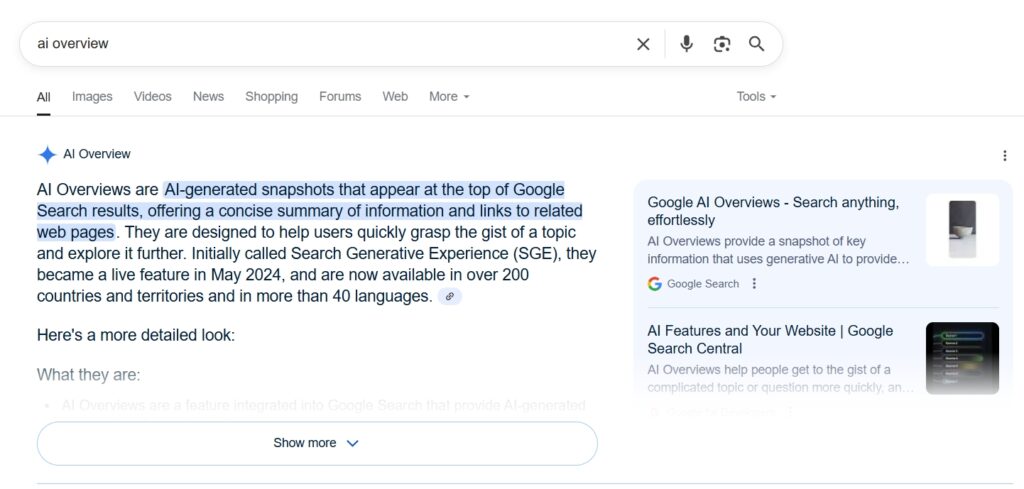
Since mid-2025, AI Overviews (formerly SGE – Search Generative Experience) have become one of the most disruptive features on Google’s search results pages. Instead of just showing links, Google now uses generative AI to summarize answers directly at the top of the SERP—pulling content from multiple websites.
For local service businesses, this shift is a double-edged sword:
✔ Opportunity – If your site is cited in an AI Overview, you gain instant visibility and authority.
✘ Risk – If you’re ignored, users may get all the answers they need without ever clicking your site.
This guide explains:
- What AI Overviews are and how they work
- Why they matter for local SEO after Google’s July 2025 Core Update
- How to optimize your site to increase the chance of being featured
What Are Google’s AI Overviews?
AI Overviews are Google’s AI-generated summaries that appear at the very top of search results for many informational queries. They:
- Present a paragraph or bullet-point answer to a query.
- Pull information from multiple pages across the web.
- Provide source citations (clickable links) below or beside the summary.
- Sometimes include images, product carousels, or videos.
For example, a search for “how to fix a leaking water heater” might show:
- A categorized breakdown of leak types (e.g., tank leak, valve leak, pipe connection leak).
- Individual step-by-step fixes for each leak type, summarized in short bullet points.
- A carousel of related YouTube videos, each showing how to address a specific type of leak.
- Citations to multiple authoritative home maintenance sites providing detailed guidance.
According to early analyses, only ~17% of AI Overview sources are from the traditional top 10 search results, while 66% are from beyond page one. This means new opportunities for smaller sites—if your content is optimized.
Why AI Overviews Matter for Local SEO
1. Higher Visibility, Even Without Clicks
If your site is cited, your brand name appears prominently in the AI summary—even if users don’t click through. This builds brand authority.
2. Level Playing Field (Sometimes)
Unlike traditional SERPs, AI Overviews often pull from niche or highly relevant sources, not just big platforms. Google wants diverse viewpoints.
3. Direct Competition With Informational Content
Local service sites that only have salesy pages are at risk. Informational, experience-driven content (e.g., troubleshooting tips, FAQs) is more likely to be cited.
4. Impact on Click-Through Rates
Even if you rank high organically, AI Overviews might reduce clicks to your page unless you are included as a cited source.
How to Get Featured in AI Overviews
Unlike traditional SEO, there’s no guaranteed way to force inclusion. But Google favors content that meets its E‑E‑A‑T and helpful content standards. Here’s how to improve your odds:
1. Focus on Informational, User-First Content
- Answer specific questions clearly and directly.
- Use natural language as if you’re explaining to a customer (“First, turn off the power…”).
- Cover complete solutions, not just a brief teaser.
2. Demonstrate E‑E‑A‑T (Experience, Expertise, Authority, Trustworthiness)
- Share real-life experience (case studies, before/after photos).
- Attribute content to qualified staff (“Written by John Smith, Licensed Plumber”).
- Cite reputable sources where applicable.
3. Structure Content for Easy AI Parsing
- Use H2/H3 question-based headings: “How do I know if my AC needs repair?”
- Format answers in bullet points or numbered steps.
- Keep paragraphs short (2–3 sentences) for scannability.
4. Use Schema Markup
- Implement FAQ, How-To, and Article schema to help Google understand your content hierarchy.
- Ensure images have descriptive alt text.
5. Keep Content Fresh and Updated
- AI Overviews tend to favor recently updated pages.
- Update older guides with “2025 tips” or new local regulations.
6. Create Multimedia Assets
- Include images and videos within guides.
- Add video schema—Google often pulls video snippets into AI Overviews.
7. Write for Conversational Queries
- AI Overviews are designed for natural language questions (often voice search).
- Use Q&A format in your blog posts.
AI Overview Optimization Checklist
| Task | Why It Matters | Done? |
|---|---|---|
| Write clear, step-by-step answers | More likely to be cited in summaries | ☐ |
| Use H2/H3 with question format | Helps Google parse Q&A structure | ☐ |
| Add FAQ & How-To schema | Improves eligibility for AI Overview & snippets | ☐ |
| Show credentials & cite sources | Boosts E‑E‑A‑T trust signals | ☐ |
| Update content regularly | AI prefers fresh, recent info | ☐ |
| Add images & short videos | Increases multimedia inclusion chance | ☐ |
Will Being Featured Bring Traffic?
Even if clicks decrease, AI Overview citations boost brand visibility and trust. Users who see your brand repeatedly in these summaries are more likely to call or hire you later—especially for local services.
Think of AI Overview optimization as branding within the SERP. The goal isn’t just immediate traffic; it’s long-term authority.
Final Thoughts
AI Overviews are here to stay. For local service sites, the key is to act like a helpful publisher—not just a service advertiser. Publish experience-backed, structured, and up-to-date content that solves real problems.
When combined with zero-click optimization (snippets, local packs), you can maintain strong visibility—even as Google answers more questions directly on its platform.
Next Step
Read our practical guide: Optimizing for Featured Snippets and Local Packs to learn how to occupy other high-visibility SERP features and drive leads directly from search.