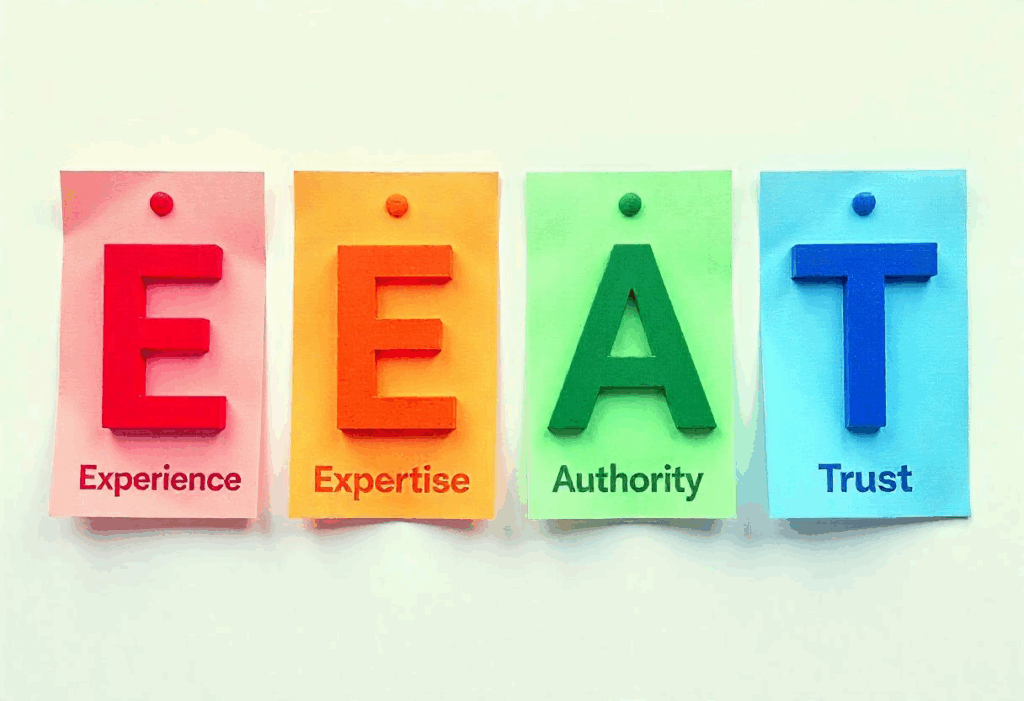
Google’s search algorithm has evolved rapidly, and E‑E‑A‑T—short for Experience, Expertise, Authoritativeness, and Trustworthiness—has become a critical factor for determining which websites deserve top visibility. If you’re running a local service business (plumbing, HVAC, clinics, law firms, or any “Your Money or Your Life” field), understanding and optimizing for E‑E‑A‑T can be the difference between staying buried on page two and dominating your local market.
This guide explains what E‑E‑A‑T is, why it matters more than ever after Google’s July 2025 Core Update, and provides a practical checklist to improve your E‑E‑A‑T signals—even if you’re a small local service provider competing against big platforms.
What Is E‑E‑A‑T and Why It Matters
E‑E‑A‑T is Google’s framework for evaluating content quality:
- Experience – Does the author or business have first-hand, real-world experience relevant to the topic?
- Expertise – Does the content demonstrate professional knowledge or skill?
- Authoritativeness – Is the website or author recognized as a credible source within its niche?
- Trustworthiness – Can users (and Google) trust the information provided? Are business details accurate and transparent?
Originally introduced as E-A-T in Google’s Quality Rater Guidelines, Google added the extra “E” (Experience) in late 2022 to emphasize real-life, hands-on knowledge. By 2025, E‑E‑A‑T isn’t just for health or financial sites—it applies to nearly all industries, especially those impacting people’s lives or wallets (YMYL).
For local service sites, strong E‑E‑A‑T helps Google determine:
- Whether your plumbing advice is written by a real plumber who has done the work (Experience).
- Whether your clinic’s health tips are medically sound and authored by certified professionals (Expertise).
- Whether your business is recognized locally (Authoritativeness).
- Whether customers can trust you enough to call you or hire you (Trustworthiness).
Why July 2025 Changed Everything
The July 2025 Google Core Update dramatically increased E‑E‑A‑T’s weight in rankings. Many local businesses saw their rankings crash while big platforms like Yelp or WebMD climbed higher. The reason: Google now heavily prioritizes sites that demonstrate credibility and updated, useful content. Simply having a business website isn’t enough—you need to look trustworthy online.
How to Improve E‑E‑A‑T for Local Service Sites
Improving E‑E‑A‑T isn’t about tricks or keyword stuffing; it’s about genuinely presenting your expertise and building trust signals. Here’s a step-by-step checklist designed specifically for small, local service businesses.
1. Show Real Experience (Experience)
Google now favors content that proves first-hand knowledge. For local services, this is where you can shine over generic platforms.
✔ What to Do:
- Publish Case Studies & Before/After Examples
- Add blog posts or gallery pages showing real projects, with photos or videos (e.g., “Before and After: Kitchen Pipe Replacement in [City]”).
- Include brief notes about what you did, tools used, and challenges solved—this screams real experience to both users and Google.
- Use Personal Storytelling
- In articles, reference your years of on-the-job experience: “After 15 years fixing water heaters in [City], here’s what we recommend when…”
- Include Staff Profiles with Roles
- A “Meet Our Team” page with real photos, job titles, and short bios (e.g., “John Smith – Master Electrician, 20 years in residential wiring”).
- If possible, link to staff certifications or licenses.
2. Demonstrate Expertise (Expertise)
Expertise is about proving you know your craft professionally.
✔ What to Do:
- Highlight Certifications & Licenses
- List official accreditations (e.g., HVAC certifications, medical licenses) on your homepage, service pages, and About page.
- Use badge images where allowed—e.g., Better Business Bureau, industry association logos.
- Write Authoritative Blog Content
- Publish educational articles answering common local questions:
“How Often Should You Service Your AC in [City]’s Climate?” - Attribute the article to a qualified staff member (“Written by Sarah Lee, Certified HVAC Technician”).
- Publish educational articles answering common local questions:
- Cite Reputable Sources
- When giving advice, reference authoritative resources (e.g., government guidelines, industry standards). Link to them where appropriate.
- Keep Content Accurate & Updated
- Refresh older blog posts at least semi-annually with current data or new tips.
- Outdated advice erodes perceived expertise.
3. Build Authoritativeness (Authority)
Google looks at how much the wider web recognizes you as a trusted local provider.
✔ What to Do:
- Get Featured Locally
- Try to be mentioned in local news, community blogs, or business directories.
- Sponsor local events or charities (and request a link from their site).
- Earn Customer Reviews & Testimonials
- Encourage satisfied clients to leave Google Business Profile reviews—ratings and review volume directly boost local pack visibility.
- Feature testimonials on your site, preferably with photos or video clips.
- Grow Backlinks Naturally
- Ask partners (e.g., hardware stores, real estate agents) to link to your site as a recommended service.
- Submit your business to reputable directories like Angi, HomeAdvisor, or professional associations.
4. Increase Trustworthiness (Trust)
Trust is the foundation of local SEO. Users (and Google) need to feel safe contacting or hiring you.
✔ What to Do:
- Ensure Accurate NAP Data Everywhere
- Consistent Name, Address, Phone (NAP) across your website, Google Business Profile, and directories.
- Update immediately if you move or change numbers.
- Add Clear Contact & Business Info
- Prominent phone number, email, and physical address on every page.
- Embed a Google Map for your location.
- Show Privacy & Security Measures
- HTTPS (SSL) is non-negotiable.
- Add a privacy policy and terms of service page.
- Be Transparent About Services & Pricing
- Include clear service descriptions, starting prices or ranges, and what’s included.
- Hidden or unclear pricing decreases user trust.
- Respond to Reviews & Questions
- Engage with customers on Google and social platforms—thank them for positive reviews and address negative ones politely.
E-E-A-T Quick Checklist for Local Sites
| Area | Action Item | Done? |
|---|---|---|
| Experience | Add project case studies with photos & stories | ☐ |
| Publish team bios with job titles & years of experience | ☐ | |
| Expertise | List licenses & certifications on service pages | ☐ |
| Attribute blog posts to qualified staff | ☐ | |
| Cite authoritative sources (gov, industry orgs) | ☐ | |
| Authority | Get local media mentions & directory links | ☐ |
| Encourage Google reviews & display testimonials | ☐ | |
| Trust | Ensure NAP consistency across all platforms | ☐ |
| Use HTTPS, add privacy policy & clear contact info | ☐ |
How Long Until E‑E‑A‑T Improvements Work?
Google’s algorithms need time to re-evaluate your site. Significant improvements might only show results after the next core update, which can be months away. However, some signals—like fresh content, better reviews, and improved user experience—can gradually improve rankings sooner. More importantly, E‑E‑A‑T improvements are cumulative and long-term; they’re not a quick fix, but they future-proof your site against future updates.
Final Thoughts: Competing with Big Platforms as a Local Business
Yes, large platforms like Yelp or WebMD have natural authority advantages. But local service sites have something platforms don’t: real, first-hand experience and community trust. If you can showcase that authentically online, you stand a strong chance of reclaiming visibility, even in a zero-click, AI-driven search world.
Think of your site not just as a digital brochure, but as a knowledge hub that proves you’re the go-to expert in your field. Combine that with stellar customer reviews and active engagement, and you’re sending the exact signals Google wants to see post-2025.
Next Step
Read our guide: Optimizing for Zero-Click Searches: How Local Sites Can Win SERP Features to learn how to occupy AI Overviews, featured snippets, and local packs—turning visibility into leads.